Common Name: The Concord
Concord: The supranational authority governing all magical aspects across its four member nations.
Pronunciation: (TEH-trad con-COR-dance)
Category: The Realm of Pnereth; History of the Realm; Governance and Institutions; Faith and Doctrine
Classification: Political Institution (PI-01)
Archived: Missives from Pnereth #4
Glossary Encyclopedia:
Common Definition:
The Tetrad Concordance, commonly called the Concord, is the supranational authority governing magical practice, doctrine, Rite of Desmos, education, prophecy, and aether stewardship across its four member nations. While Aura, Igni, Tera, and Unda retain sovereignty over their civil affairs, authority over magic rests with the Concord.
Archival Note: Despite its considerable influence throughout Pnereth, Concord authority does not extend to the Kingdom of Toler. Relations between Toler and the Concord are governed through diplomatic accord.
Historical Context:
The Concord was established in 4160 Tissian Era, in the aftermath of the Mortal War, when generations of competing national authorities brought Pnereth to widespread devastation. Before its foundation, the nations governed magic independently. Nations maintained their own doctrines surrounding Desmos and the acceptable use of aether. During the war, these differences became increasingly dangerous as Desmos was weaponized, aether-rich territories were contested, and the Divine Crafts became instruments of national power.
The war ultimately produced a radical political conclusion that no mortal government could be permitted sole authority over magic. The resulting Concord allowed Aura, Igni, Tera, and Unda to retain control over their civil affairs (taxation, trade, armies, succession, etc.) while surrendering authority over Desmos, magical licensing, aether regulation, the Divine Crafts, and interpretation of divine will to a centralized institution seated in neutral Sentra.
Branches of the Concord:
Concordance authority is organized through four principal sanctions, each representing one component of the unified governance established following the Mortal War:
- Ortharcs, the Branch of Judgment – Custodians of doctrine, virtue, ritual, and moral law. The Ortharcs determine heresy and doctrinal compliance and oversee the militant Orthosynax.
- Sophontes, the Branch of Knowledge – Custodians of education, scholarship, archives, and accepted historical record. Their Grammats preserve knowledge while Didaskals oversee its instruction.
- Mantissa, the Branch of Sight – The prophetic sanction responsible for receiving and interpreting fragmented visions attributed to the divine. Their interpretations have long influenced Concord policy, succession, and the perceived legitimacy of major political events.
- Horisto, the Branch of Limit – Scholars and regulators of magic, aether, leyline stability, and magical law. The Horisto establishes acceptable thresholds of magical practice, advises the Concord on restriction, containment, and preservation, and oversees the Curetes Guard.
Together, these sanctions reflect the central philosophy upon which the Concord was founded: doctrine, law, magical regulation, and governance cannot safely exist apart.
Leadership of the Concord:
Supreme authority rests with the Five High Archons. Each of the four sanctions is represented by its High Archon, while a fifth seat exists independently of the sanctions and serves as a bridge between Concordance authority and the political interests of the four nations.
The roles of the High Archons are:
- High Archon of Ortharcs (High Ortharcs) – Oversees doctrine, moral law, investigations of heresy, and the Orthosynax.
- High Archon of Sophontes (High Sophontes) -Oversees education, scholarship, archives, and preservation of the accepted historical record.
- High Archon of Mantissa (High Mantissa) – Oversees the interpretation of prophecy and divine will and advises the Concord on matters of prophetic significance.
- High Archon of Horisto (High Horisto) – Oversees magical regulation, aether stewardship, Convergence access, licensing, and the study and containment of dangerous magical practices.
- High Fifth Archon – Occupies the sole voting seat unaffiliated with a sanction and mediates between the Concord’s institutional authority and the political interests of its member nations.
Only the Five High Archons possess voting authority within the Concord.
Current High Archons:
- High Ortharcs = Armo Vaelor (4348-present)
- High Sophontes = Savantill “Savi” Zarethi (4198-present)
- High Mantissa = Pythia Ostrelle (4299-present)
- High Horisto = Fallion Caldris (4276-present)
- High Fifth = Lucian Akilion (4445-present)
Aura, Igni, Tera, and Unda each maintain representation through a National Delegation, whose delegates may address the High Archons, submit formal objections, present national concerns, and advocate for policy. They possess no vote, however, and cannot override Concordance doctrine or magical law.
Current National Delegation:
- Aura Royal Legate = Lord Perrick Pell, Master of the Royal Gryps
- Igni Concordate Marshal = Akelis Orenth
- Tera Steward of Well-Being = Hestia Briarst
- Unda Royal Legate = Princess Vitalia Karsyn-Vaelor
The distinction is foundational to the institution: the nations govern their people, but they do not govern their magic.
The Charter of the Concord:
This principle was formalized within the Charter of the Concord, the foundational covenant establishing the Concord’s authority. The Charter preserves national sovereignty while explicitly removing magic from national possession, declaring aether a divine resource to be governed collectively rather than claimed by any crown.
It likewise establishes the Octave of Virtue—fidelity, harmony, humility, perseverance, patience, courage, honor, and stewardship—as the moral foundation of rightful magical power.
For nearly three centuries, this system has been credited with preventing another Mortal War, protecting the Divine Crafts, standardizing the Trials of Virtue and the Rite of Desmos, and maintaining relative peace between the four nations.
Modern Concordance ideology has increasingly emphasized preservation through restraint as aether diminishes throughout Pnereth. Magical regulation, once intended primarily to prevent national monopolization and catastrophic warfare, now extends deeply into civilian practice, education, licensing, and access to magical resources.
To its followers, such oversight remains the necessary price of peace. To its critics, the distinction between stewardship and control has become increasingly difficult to find.
Concordance Ideology:
Although the Concord maintains a unified doctrine, political attitudes toward its authority vary considerably throughout its member nations.
The ideology most closely associated with modern governance is Sola Concordia. Its adherents maintain that the Concord is imperfect but necessary: its institutions may require reform, but dismantling the system risks returning Pnereth to the division and magical warfare that preceded its creation.
Sola Concordia therefore favors reform through existing institutions, preservation of the balance between nations, and cautious regulation of Desmos and aether. Its strongest cultural and intellectual roots are found in Igni and the southern region of Aura.
Two major ideological traditions frequently challenge its assumptions:
Sola Elitum – Most strongly associated with Unda, Sola Elitum accepts Concord authority while advocating a more hierarchical interpretation of its doctrine. Deoi are understood as individuals demonstrably favored by the gods and Desmos as evidence of worthiness sufficient to justify elevated political and social authority. To its followers, hierarchy does not corrupt divine order, it reflects it. This ideology has grown in recent years as the Diminishment continues to creep across Pnereth.
Sola Custodia – Most strongly associated with Tera, Sola Custodia argues that magic is neither a possession nor proof of superiority, but a temporary responsibility entrusted to its wielder. Its adherents are often critical of centralized control over aether and Desmos and maintain that the Concord has gradually exceeded the stewardship mandate upon which it was founded.
While these traditions are often described as opposing ideologies, their boundaries are neither absolute nor synonymous with national allegiance. Debate among them remains a significant influence on Concordance politics.
Symbol of the Concord:
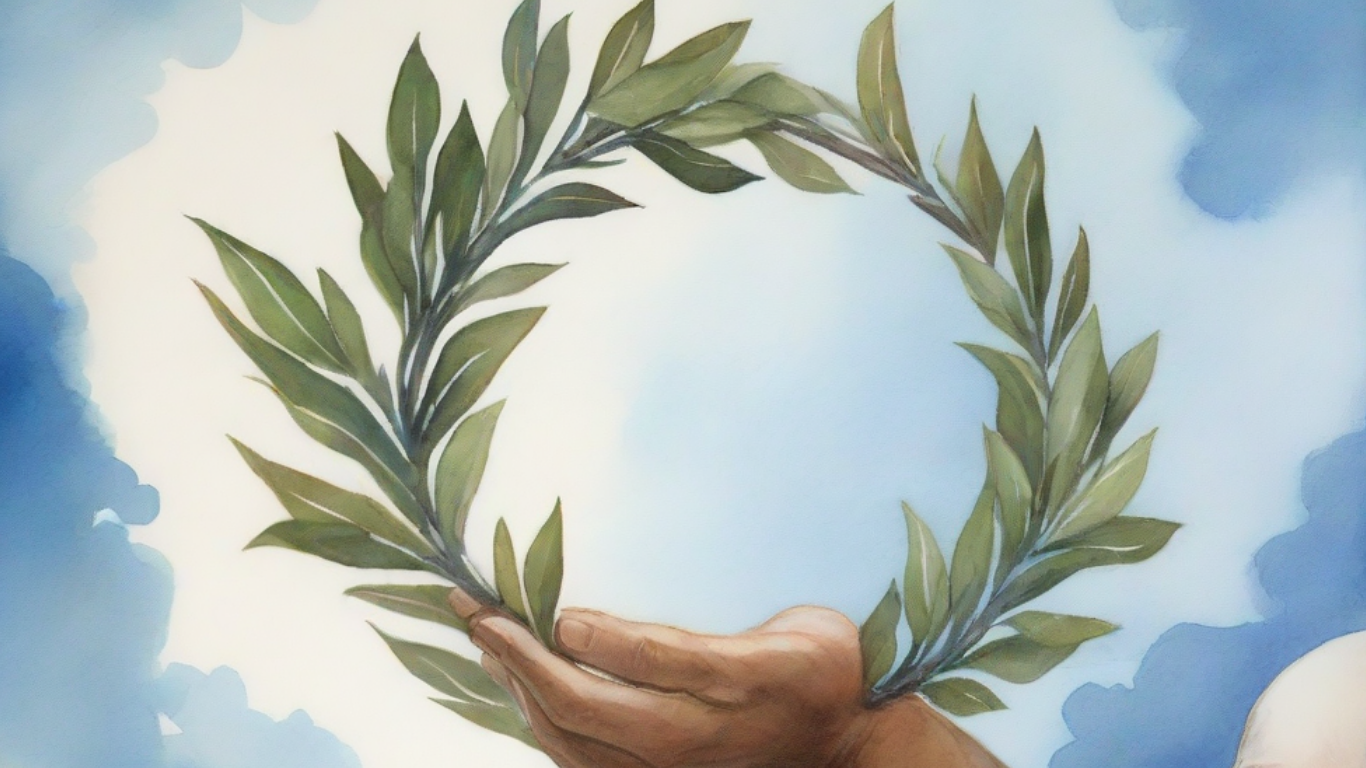
The official symbol of the Tetrad Concordance is the Kotinos of Harmiel, an ancient golden olive wreath bearing a single kyanite stone.
Tradition holds that the Kotinos was a divine gift instrumental in binding the original Charter of 4160 TE and establishing lasting accord between Aura, Igni, Tera, and Unda. It has since become synonymous with sacred peace, unity, and the authority of the Concord itself.
The original Kotinos remains under heavy guard within the Concord Chamber in Sentra, where it hangs above the seats of the Five High Archons. Its likeness appears throughout Concord territories upon banners, official seals, military insignia, and ceremonial dress.
Its cultural significance extends beyond governance. To many citizens, the Kotinos represents the belief upon which the Concord was founded: that peace between the nations can endure only so long as no single power is permitted to rise unchecked.
The precise origins and magical properties of the Kotinos remain unknown.

Pre-Mortal War Context:
A complete understanding of the philosophies that preceded the Concord and the extent to which they influenced its founding is impossible. The Burning of Venna in 4100 TE destroyed vast collections of historical, theological, and mageological records.
What surviving records remain suggest that early Concord theologians did not universally agree that diminishing aether was evidence of mortal spiritual failure. Ecological instability, wartime overuse, disrupted leylines, and competition for aether-rich territories were among several explanations proposed for the decline.
As Concordance authority solidified, however, these competing theories largely disappeared from public doctrine. The prevailing interpretation instead connected magical stability with divine alignment and mortal worthiness, providing theological justification for increasingly centralized control over who may access, study, and wield magic.
Whether this represented a sincere evolution of doctrine, deliberate institutional consolidation, or merely the elevation of one interpretation after much of the contradictory record had already been lost remains impossible to determine with certainty.
Restricted archival scholarship continues to debate the question.
Organized Opposition:
Featherfall is the most prominent organized opposition to modern Concord authority. Though frequently described by Concord officials as a radical or anti-Concord movement, Featherfall’s precise organization, leadership, and objectives remain poorly understood outside its membership.
Publicly attributed rhetoric challenges the Concord’s claim that preservation requires centralized control of magic. The Featherfall movement has criticized unequal access to aether, the elevation of Deoi within political and social hierarchies, and the expanding authority of Concord institutions over the four nations.
Concordance authorities have linked Featherfall to acts of sedition, theft, unlawful magical practice, and interference with Concord operations. Featherfall sympathizers dispute both the characterization of the movement and the impartiality of the institutions responsible for documenting its activities.
(See reference on 4441 TE Theft of Kotinos, Reina Thane.)
Where the Concord presents the White Feather as a symbol of promised salvation, Featherfall asks what should happen when salvation requires the structures beneath it to fall.

Leave a Reply