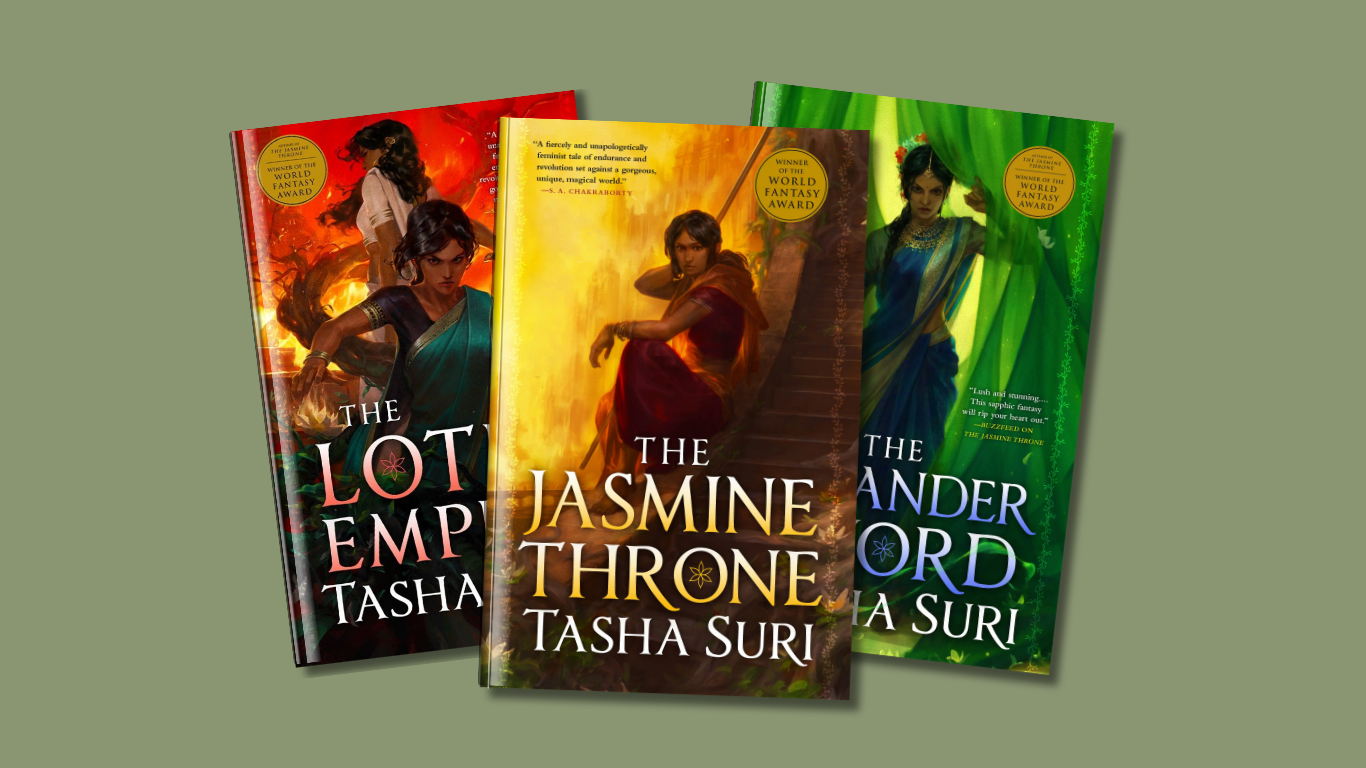
Five reasons readers of Tasha Suri’s Burning Kingdoms trilogy might feel at home in my debut epic fantasy—and three ways I’m taking my story somewhere different.
I recently finished Tasha Suri’s Burning Kingdoms trilogy, beginning with The Jasmine Throne, and somewhere between political maneuvering, complicated women, ancient magic, and the increasingly blurry line between divinity and power, I had a realization: Oh. This is why people use comp titles.
As I work toward eventually querying Project Feather, The Jasmine Throne has become one of my most important comparative titles. Not because our stories have the same plot. (They don’t.) Nor because our worlds look the same. (They definitely don’t.) What I found across the Burning Kingdoms trilogy was something we’re interested in many of the same questions:
- Who gets to wield power?
- Who decides which stories become history?
- What happens when religious authority becomes political authority?
- Can you change a broken institution from within or does meaningful change eventually require dismantling it?
- What happens when the women those systems tried to control become powerful enough to decide what comes next?
If those were some of the things you loved about The Jasmine Throne, allow me to introduce you to Project Feather.

1. Women Navigating Systems of Power
One of my favorite aspects of The Burning Kingdoms is that its women aren’t simply standing outside powerful institutions shouting about how terrible they are. They are navigating them.
Priya and Malini encounter power from very different positions, but throughout the trilogy, both must determine what they’re willing to become in order to change the worlds that shaped them. Political authority, religious authority, cultural expectations, personal ambition, and survival are constantly colliding.
Project Feather places its protagonist directly inside that collision.
Vayda Vaelor has spent her entire life within Pnereth’s most powerful institution, the Tetrad Concordance. She is educated, politically connected, extraordinarily privileged, and believed to be the prophesied White Feather destined to usher Pnereth into a new era. She doesn’t begin her story wanting to overthrow the system. She actually believes she can make it better.
The problem is that the more of Pnereth she sees, the harder it becomes to separate the institution she loves from the injustices it has allowed. Eventually, Vayda has to ask whether changing the system from within is actually possible.
2. Prophecy Isn’t Just Magic. It’s Political.
I love prophecy in fantasy. I especially love prophecy when people start asking “Who interpreted this?” because suddenly things get messy.
Throughout The Burning Kingdoms, religion, divinity, prophecy, and political legitimacy become increasingly intertwined. Belief doesn’t exist separately from government. What people believe about the divine influences who they follow, who they fear, and who they believe deserves power.
Project Feather takes that concept and runs directly into dangerous territory with it. Pnereth has spent generations waiting for the White Feather. Vayda has spent her entire life being told she fits that prophecy. But as she breaks from the world she’s always known, she begins to notice how that prophecy isn’t simply predicting what happens next.
It’s determining who receives protection and who receives influence and who becomes useful and, most importantly in the political sense, who becomes dangerous. Because in Project Feather, being “chosen” isn’t only a divine distinction. It’s a political one.
3. Magic, Religion, and Government Are Almost Impossible to Separate
This may be one of the strongest connections between the two series for me. The magic of The Burning Kingdoms isn’t simply something characters possess so they can do cool things during fight scenes. It is connected to religion, history, cultural identity, oppression, and political authority.
That’s exactly the kind of fantasy worldbuilding I love, and it’s foundational to Pnereth. The Concord doesn’t simply govern. It regulates magic, oversees religious doctrine, interprets prophecy, directs education, and controls access to aether, the foundation of elemental magic.
In other words: The Concord controls magic so it controls society.
Project Feather begins during a period when that control is becoming increasingly difficult to maintain. Magic is changing as ancient assumptions are beginning to crack. And Vayda’s journey slowly begins revealing that some of the fundamental truths she was taught about her world may not be truths at all.
When your government has built centuries of authority upon a particular understanding of magic, discovering that understanding might be wrong isn’t merely a magical problem. It’s a political catastrophe.
4. There Aren’t Easy Good Guys
Give me morally complicated political factions and I will happily disappear into a fantasy novel for several hundred pages. One thing The Burning Kingdoms does particularly well is resist reducing its conflicts to “Empire Bad, Rebellion Good.” Characters may want liberation and still cause harm. People may oppose injustice for selfish reasons. Someone can genuinely love their people while making horrifying choices supposedly on their behalf.
Project Feather approaches its political conflict with a similar philosophy.
The Concord is deeply flawed, but it isn’t populated entirely by villains. (Honestly, most of the “villains” have good intentions behind their decisions.) Likewise, the people opposing it aren’t automatically heroes.
Throughout Book One, Vayda encounters reformers and radicals, believers and opportunists, and people who simply want to survive whatever the powerful decide to do next. And that’s important because her central question isn’t, “Who are the good guys?” It’s closer to, “What actually creates meaningful change and what am I willing to destroy to achieve it?” She desperately wants there to be a clean answer.
Unfortunately for her, I am the author…
5. Romance Exists Inside the Political Story
I love romance, but I also love when characters are attempting to fall in love while their circumstances make doing so an absolutely terrible idea.
The relationship between Priya and Malini matters enormously to The Burning Kingdoms, but their relationship never exists inside a vacuum. Their loyalties, ambitions, identities, responsibilities, and visions for the future constantly complicate what they mean to one another.
Project Feather also places romance firmly inside its larger conflicts. Vayda’s relationships develop alongside competing loyalties, family expectations, political alliances, and prophecy.
However, that is not to say my book does not include romance. There’s slow burn emotions threaded through Book One resulting in a love triangle that is physically tearing my heart out as I write it… BUT there is also the small issue of potentially determining the future of civilization. You know, typical dating problems, right?
So How Is Project Feather Different?
A good comp title shouldn’t mean two books are interchangeable. In fact, I think the differences are just as important as the similarities. The Burning Kingdoms helped me understand the readership Project Feather might eventually belong beside, but my story has its own mythology, structure, and central question.
1. My Chosen One Starts at the Top
This is probably the most important distinction.
Vayda isn’t trying to gain access to power. She already has it. She is the daughter of two extraordinarily influential people. She was raised within the Concord. She understands politics. She has access to leaders most citizens will never meet and an education many would die to receive. Plus, let’s not forget she’s believed to be the prophesied savior of both magic and the entire realm. To say she is privileged may be an udnerstatement…
At the beginning of Book One, Vayda genuinely believes she can use those advantages to make the world better. Her story isn’t about being rejected by a corrupt institution and deciding to fight it; it’s about being welcomed by it and prepared by it. Even celebrated by it.
Yet eventually she is forced to confront what accepting that power offers and what it would require her to become, which leads to one of the questions at the heart of the entire series: What if the Chosen One realizes nobody should have the power she’s destined to inherit?
2. The Story Is Built Around Deadly Trials
Project Feather combines political epic fantasy with something I will apparently never outgrow, my love of Greek mythology.
At the beginning of the novel, Vayda joins an expedition across Pnereth to undertake four ancient Trials of Virtue, loosely inspired by the mythological tradition of heroic labors. Four nations. Four gods and their elements. Four opportunities for everything to go horribly wrong.
But the trials aren’t simply obstacles Vayda needs to survive. They physically remove her from the halls where she learned politics and force her into communities living under the policies she’s spent years discussing in theory.
This is where my lived experience of working in both the nonprofit and government sectors really come into play… It’s one thing to believe you know how to fix a country from a council chamber. It’s another to meet the people actually living with the consequences.
3. Virtue (not Power) is at the Heart of the Magic
Project Feather has elemental magic, but underneath that system is virtue. Each element corresponds to two of Pnereth’s eight central virtues:
- Air asks for perseverance and humility.
- Water asks for fidelity and harmony.
- Fire asks for patience and courage.
- Earth asks for honor and stewardship.
The Trials of Virtue aren’t about proving that someone perfectly embodies those qualities. Instead, they’re about balance. Participants must learn to master self, serve others, and transcend self—a philosophy that becomes increasingly important as Vayda begins questioning what it actually means to be “worthy” of power.
Project Feather isn’t ultimately interested in asking who is powerful enough to save the world, but what makes someone worthy to try.
If You Loved The Jasmine Throne…
I can’t promise Project Feather will give you another Burning Kingdoms.
And I wouldn’t want it to.
What I can say is that if you love complicated women navigating dangerous political systems, ancient magic tangled with faith, consequences of power plays, governments built upon questionable histories, morally complicated revolutions, and romance happening at the absolute worst possible political moment… you might feel at home in Pnereth.
I think The Burning Kingdoms and Project Feather are interested in what happens when women become powerful enough to change the systems that shaped them.
My book simply begins with a woman who has spent her entire life being told she will save the world. Yet now she has to decide whether saving it means becoming the person everyone expects, or dismantling the very system that made her its chosen one.

Leave a Reply